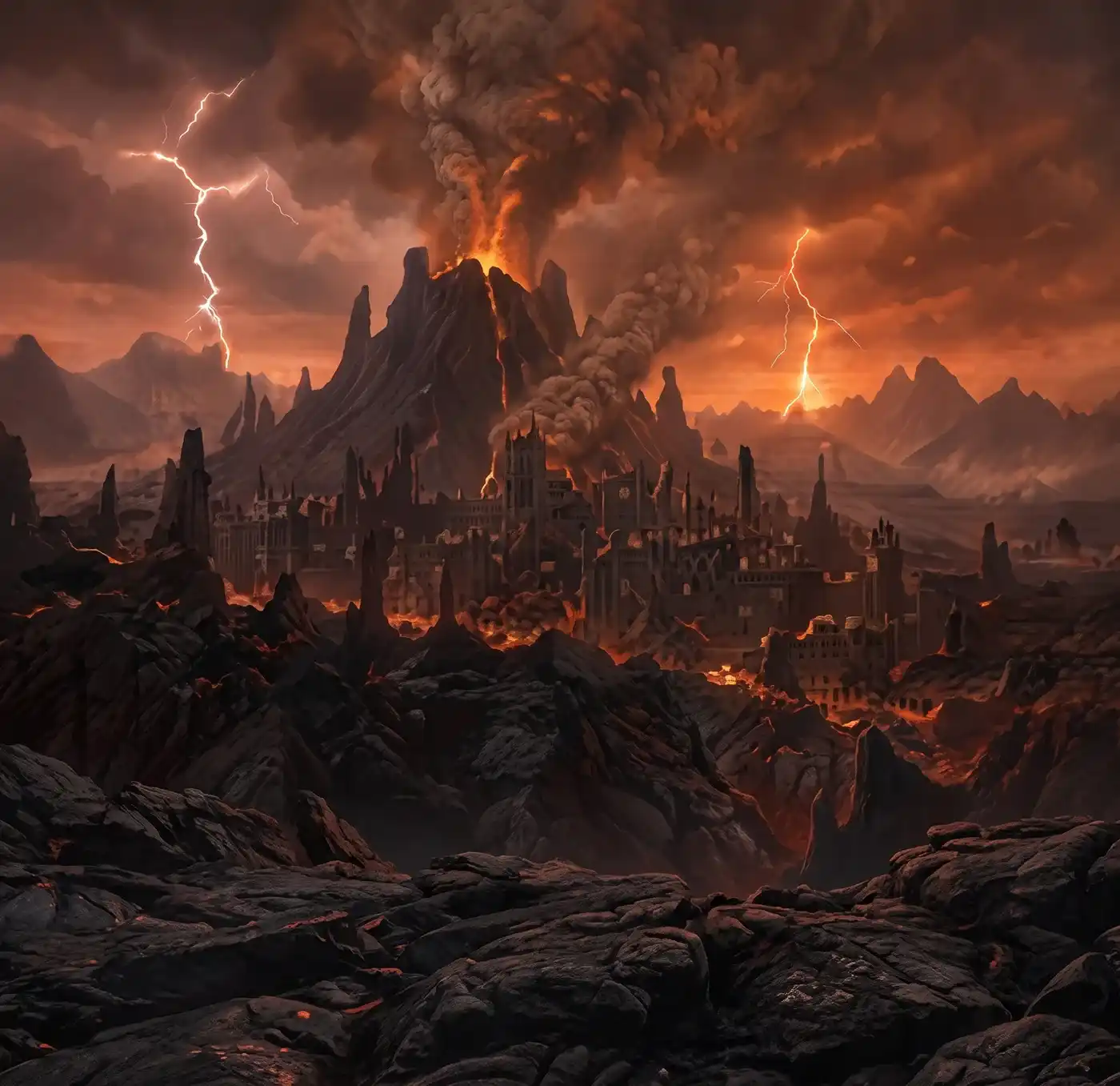
House Targaryen was one of the dragonlord families of Old Valyria. Twelve years before the Doom, the family left Valyria for Dragonstone, allowing its line and dragons to survive the destruction of the Freehold. The last Targaryen dragon later died in 153 AC during the reign of Aegon III, although dragons eventually returned when Daenerys Targaryen hatched three eggs generations later.
Generations after the Doom, Aegon Targaryen and his sister-wives Visenya and Rhaenys began the conquest of Westeros from Dragonstone. Aegon rode Balerion the Black Dread, Visenya rode Vhagar, and Rhaenys rode Meraxes.
Dragonfire played a decisive role in the conquest. Harren the Black and his sons died when Balerion burned Harrenhal after Harren refused to surrender.
At the Field of Fire, Aegon, Visenya, and Rhaenys used all three dragons against the combined armies of King Mern IX Gardener and King Loren I Lannister. Mern and much of House Gardener died in the battle, while Loren survived and later submitted to Aegon.
Torrhen Stark, the King in the North, chose to bend the knee rather than fight the Targaryen dragons. By the end of Aegon's Conquest, six of the Seven Kingdoms had submitted to Targaryen rule, while Dorne remained independent.
The Targaryen dynasty later faced one of its most destructive internal conflicts, the Dance of the Dragons, a civil war fought between rival claimants Rhaenyra Targaryen and her half-brother Aegon II Targaryen. Their struggle for the Iron Throne divided the realm and led to devastating losses among both the royal family and their dragons.
Although the Targaryens survived the Dance of the Dragons, later generations faced further rebellions and wars, including the Blackfyre Rebellions. The dynasty continued to rule Westeros for many generations after Aegon II.
Targaryen rule finally ended during Robert's Rebellion in 283 AC. The last Targaryen king to sit the Iron Throne was Aerys II Targaryen, widely known as the Mad King, who was killed during the Sack of King's Landing before Robert Baratheon took the throne.
The Doom of Valyria
The Valyrian Freehold was once the dominant civilization of the Valyrian peninsula, famous for its dragonlords, magic, language, and vast influence across Essos. In 102 BC, the Doom of Valyria destroyed the Freehold and devastated its homeland.
House Targaryen did not flee Valyria after the Doom. Twelve years earlier, Daenys Targaryen, later known as Daenys the Dreamer, had a prophetic vision of Valyria's destruction. Her father, Aenar Targaryen, believed her warning and moved his family, wealth, and dragons to Dragonstone, the westernmost outpost of the Valyrian Freehold.
The Targaryens remained on Dragonstone for more than a century after leaving Valyria. Because they had departed before the Doom, they became the only surviving family of Valyrian dragonlords. Generations later, Aegon Targaryen and his sister-wives Visenya and Rhaenys launched the conquest of Westeros from Dragonstone with their dragons Balerion, Vhagar, and Meraxes.
At the beginning of Aegon's Conquest, Aegon Targaryen landed with his forces at the mouth of the Blackwater Rush and established a crude wood-and-earth fortress known as the Aegonfort on the highest nearby hill. A settlement gradually grew around the fort and later developed into King's Landing, the capital of the new Targaryen realm.
Dragons
During the Field of Fire, Aegon Targaryen's army of roughly 11,000 men faced a combined force of about 55,000 soldiers from the Reach and the Westerlands. Although the Targaryen lines initially struggled, Aegon, Visenya, and Rhaenys unleashed Balerion, Vhagar, and Meraxes from the air.
The three dragons set the dry battlefield ablaze. Around 4,000 men were burned, including King Mern IX Gardener and many members of House Gardener, while King Loren I Lannister escaped the flames and later submitted to Aegon. The victory helped secure the Reach and the Westerlands for the new Targaryen realm.
Dorne was the major exception to Aegon's conquest. The Dornish successfully resisted Targaryen rule and remained independent for generations. Dorne was eventually united peacefully with the Iron Throne in 187 AC during the reign of Daeron II Targaryen, following an agreement with Prince Maron Martell and Maron's marriage to Princess Daenerys Targaryen.
Technology
The known world combines medieval-style technology with older magical traditions. Westeros makes extensive use of stone masonry, mining, glass, roads, ships, metalworking, and ravens for long-distance communication, while parts of Essos preserve remarkable works such as Valyrian roads and fused-stone structures. Some ancient landmarks, including the Wall and Storm's End, are associated in legend with magic, although these accounts are not always treated as established history. Old Valyria, however, is repeatedly associated with powerful sorcery rooted in fire and blood, including magical stoneworking and the use of dragons alongside its armies.
Language
The Common Tongue is the dominant language spoken across most of Westeros. Essos is far more linguistically diverse, with languages and dialects that developed across the Free Cities, Slaver's Bay, the Dothraki Sea, and other regions.
High Valyrian was the language of the ancient Valyrian Freehold. After the Doom of Valyria, regional forms evolved into the bastard or Low Valyrian languages spoken in the Free Cities, including Pentoshi. In Slaver's Bay, local Valyrian dialects were strongly influenced by Old Ghiscari, an older language that is now largely forgotten. Explore Valyrian-inspired naming with the Valyrian Name Generator.
Blood of Valyria
The blood of Old Valyria is most famously associated with distinctive Valyrian features such as silver-gold or platinum hair and eyes in shades of purple, lilac, or violet. These traits are strongly associated with House Targaryen and can also appear among other families of Valyrian descent, including House Velaryon. Valyrian nobility placed great importance on preserving their bloodlines, and the Targaryens continued some of those marriage traditions after settling on Dragonstone. Valyrian ancestry does not provide fixed game-style bonuses such as increased persuasion, endurance, or universal immunity to fire.
Valyrian Steel
Valyrian steel is a magical alloy first forged in the Valyrian Freehold. Its creation involved repeatedly folding the metal together with lost spells, and Valyrian sorcery was traditionally associated with blood and fire. The secret of creating new Valyrian steel was lost after the Doom of Valyria, although smiths in Qohor can still rework existing Valyrian steel.
Valyrian steel blades are lighter, stronger, harder, and sharper than ordinary castle-forged steel. They are usually dark grey or nearly black and display distinctive rippled patterns from the folding process. Their edges remain exceptionally sharp even after centuries of use.
Valyrian steel weapons became priceless heirlooms among noble houses. Archmaester Thurgood's Inventories recorded 227 Valyrian steel blades in Westeros, although some have since been lost or disappeared from history. Famous examples include Longclaw, Heartsbane, Blackfyre, Dark Sister, Oathkeeper, and Widow's Wail.
Magic
Magic was not completely erased from the known world after the Doom of Valyria, although many people in Westeros came to believe that its power had faded. The maesters of the Citadel generally treated the higher mysteries with skepticism, while magical traditions continued to survive in places such as Qarth, Asshai, and among followers of R'hllor.
Pyromancers and firemages continued to practice arts connected with fire, and the Alchemists' Guild preserved the dangerous process of producing wildfire. In the east, warlocks, bloodmages, sorcerers, and other practitioners were still associated with supernatural powers and ancient knowledge.
As dragons returned to the world, several magical practices also appeared to grow stronger. The exact relationship between dragons and magic is not fully explained, but characters within the story repeatedly notice that old powers and mysteries seem more potent than they had been for generations.
← BACK TO BLOG