Types of Dragons
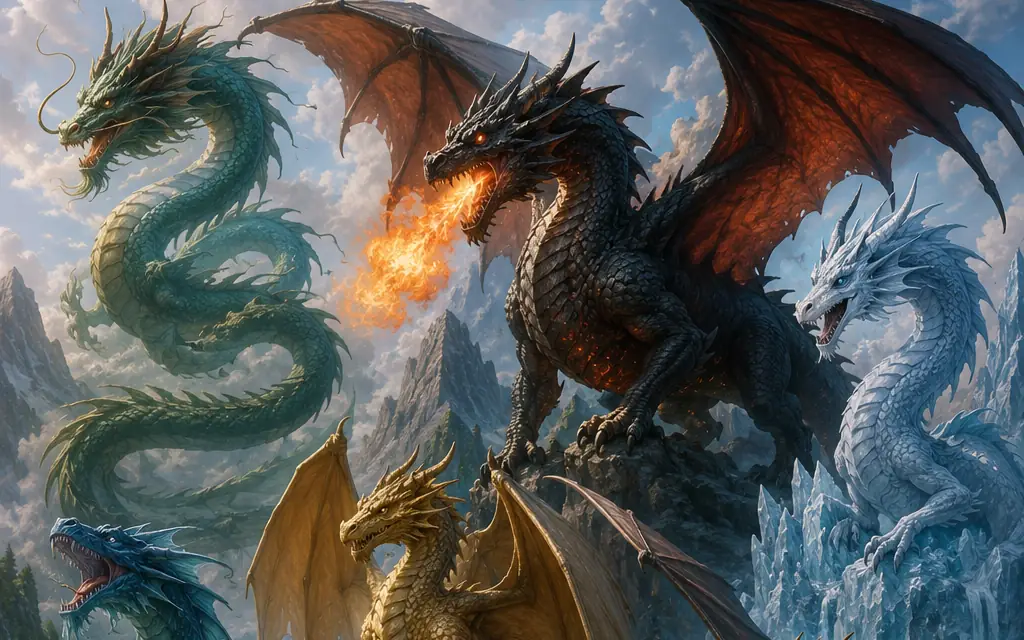
Ever stop to wonder just how many types of dragons there are? You’re not alone in initially picturing every single one in that same generic, slightly-snotty, fire-breathing kind of image; the reality is actually much more varied than you might assume. Dragon species appear all throughout myths and fantasies in vast quantities, but it’s not like they’re all designed with the same features, and they certainly don't all adhere to the same universal rules.
There are dragons with four legs, ones with only two, ones with no legs or wings at all, dragons with different elemental associations like fire, ice, storms, rivers, mountains, or pure magic; the list goes on!
Each culture seems to have imagined this mythical creature in its own unique way-therefore, there is no single list that contains every single type of dragon out there, and we often rely on classifications relating to their appearance, cultural origins, the environments they occupy, and, of course, the kind of powers they’re equipped with. It should not come as a surprise to anyone to find that a European dragon looks completely unlike an Eastern one, and that there’s also creatures like a wyvern, wyrm, or lindworm that present with a very different type of body structure to the typical four-legged, two-winged dragons in any well-regarded fantasy world.
Ready to dive into the world of some utterly amazing creatures? Today, we will be taking a closer look at some of the 12 most iconic and interesting species found in folklore and in modern fantasies, observing their general traits in terms of how we identify them based on appearance, what sorts of power sources each has, and what may make it unique compared to any of the others.
Let's Take a Look at 12 Dragon Varieties:
| Dragon Type | Anatomy Used as Identifier | Wings? | Notable Attributes: |
|---|---|---|---|
| Western or European Dragon | Four legs, tail | Two | Fire, raw strength, flight |
| Eastern or Chinese Dragon | Long serpentine body | No visible wings (usually) | Water, rain, weather, wisdom |
| Japanese Dragon | Long snake-like body | No visible wings (usually) | Water, oceans, storms, Japanese mythology |
| Wyvern | Two legs, body functions as wings | Two | Flight, claws, often venemous |
| Drake | Four legs | No | Raw strength, land-based combat, no flight |
| Wyrm | Long serpent-like body | No | Ancient magic, the land, caves |
| Lindworm | Long serpent-like body, possibly two legs | No | Poison, riches, deep wilderness |
| Amphiptere | Snake-like body with wings | Two | Flight, wind, magic |
| Hydra | Snake-like with multiple heads | No | Regen, multiple heads (attack) |
| Sea Dragon | Aquatic reptile-like body | Varies | Water, storms, ocean elements |
| Fairy Dragon | Small and magical creature | Yes (sometimes with butterfly wings) | Pure magic, illusions, the flora and fauna of nature |
| Elemental Dragon | Varies-often an archetype defined by an element | Varies | Fire, ice, water, storm or earth powers |
Note that these distinctions are extremely useful for comparing fantastic beasts, but we are of course speaking about folklore, and thus there is simply no way for us to scientifically classify these mythological beings! Their features change in between each tale from culture to culture or game world to world, so feel no distress or confusion if there are occasional overlaps and differences; it is simply the way of things!
How dragons really got categorised
If one hears the descriptions of several creatures referred to as different kinds of dragons it may be in recognition of one or a combination of a variety of factors.
- Their body shape: Is it a quadrupeds and winged beast? Perhaps just a pair of hind legs and giant wings attached? Or a long, winding serpent that we would think is a dragon anyway?
- Their origin: Europeans and Chinese both had drastically different views on dragons which therefore shaped each individual beast's appearance and any believed to be associated myths surrounding it which illustrates why it isn't feasible to use a diagram of 'dragon types' based on anatomical specifications alone.
- Their elemental attribute: Our current fantasy literature is chock full of draconic beings who are tied in some way to an element such asfire, ice or storm dragons, that list could go on. This attribute often appears in the age-old myths too.
All of those distinctions determine in part the identity of the creature: a typical 4-legged, 2-winged dragon is a Western kind of dragon whereas one that has 2 legs that act as two enormous wings that serve as forelimbs would be a wyvern.
It is very common for modern fantasy literature to combine these features and assign to them a dragon that possesses traits of both, e.g.
The book The Book of Dragons* combines creatures that appear as reddishwinged dragons and other forms of them with a magical ice dragon and dragons made of pure purple fire.
What this proves then is that there are essentially no definite, clear cut ways of dividing all dragons into distinct categories – every definition used is subjective to an aspect one wishes to identify.
The list that will now follow has described 12 variations that appear within myths and fantasy for the reader; remember that they're just examples!
1. The Western or European Dragon
This is surely the archetypal example one would picture instantly. Defined typically by what is envisioned within modern fantasy tales the traits are;
- A 4-legged, winged beast
- Scaly skin
- A strong jaw and mouth
- A menacing tail
- A reptilian and sometimes horned or ribbed skull
- A heavy and robust physical constitution
Fire breathing creatures like these are very frequently found lurking around mountain tops, ancient ruins, caves and anywhere else on the vast, empty land that it can find.
These creatures are associated very much with the guarding of treasure and they use both their flying capacity and their powerful fire breath to present and enormous risk.
The Western dragon has three dominant strengths over many other fantastic creatures – its power, the capability for flight, and pure destruc-tion which the Eastern Dragon lacked.
Western Dragon Powers include:
- Fire breathing
- Soaring through the skies
- Colossal might
- Extreme resilience of scales
- Talons/Fangs
- heightened physical sense
- Magic-resistance
- Immortality (a relative term among powerful beings)
2. The Eastern or Chinese Dragon
Contrary to what one may see with the aforementioned Western Dragon, Eastern dragons bear very few similarities. Chinese dragons present primarily as snake-like with long and rather elaborate bodies as opposed to those of European monsters which often appear much more compact, quadrupedal.
Traits that we commonly identify with a Chinese dragon;
- Snake-like body
- Quadrupedal form
- Powerful, cutting talons
- Horns or antler like structures upon the skull
- Often have a set of whisker-like appendages and a mane or crest upon its head
- Wingless
Traditionally when we see these creatures represented the lack of wings in Chinese dragons is largely offset by the myth, it claims that the creature can fly through the air unaided and its link to the weather and natural element of water respectively are not something new within the mythology of this fantastical species.
With this it can be gathered that they hold far greater relevance in myths than simply appearing as the equivalent oriental version of fire breathing creatures because they have cultural significance with elemental magic that they control which the other fails to offer by default; which explains why some things cannot be bundled into the same category of dragon and explained away so easily.
Eastern Dragon Powers in chinese mythology:
Depending on the myth associated with them these dragons can control;
- The rain
- The rivers and other bodies of water
- The oceans
- The storm clouds
- The weather as a general attribute
- Supernatural flight
- Protectiveness
- Unbridled power
- Wisdom
They're very much a classic illustration of what we imagine when referring to anEastern dragon and this can be attributed to their sleek and long serpentine physiques which set them apart instantly.
3. The Japanese Dragon
These are somewhat closely related to other creatures from East Asian myth in the Eastern Dragon having a particular common visual similarity between it and many Japanese dragons, being serpentine in appearance.
The Japanese dragon's affiliations tend to be related greatly to nature however with particularly strong emphasis upon the aspect of Water as such.
This type of dragon will possess specific Japanese traits that make its legend stand out; it relates closely and often quite strongly to Water for the reason that they are considered and widely identified with the Japanese seas and the rains that pour down onto lands in storms.
When looking for Japanese dragons it can also be easily illustrated that they do not usually carry a large bat like shape around their 'face' as Western dragons might.
One of the main issues when distinguishing the types of dragon is that we can often simply classify all of them into "anatomical" type as the defining feature that sets each species of dragon apart from its counterparts.
If this is what one seeks it is better then to view Japanese Dragons as creatures of Japanese cultural mythology.
4. The Wyvern
Ah yes, the wyvern - just one other one of the few dragon varieties that is so commonly misidentified.
The standard wyvern contains the attributes;
- A pair of hind legs
- Two large wings that act also as forelimbs, i.e.
- It has no visible arms; it only possesses the 2 large legs which have also been formed into winged extremities.
- Long tailed physique
- Body resembles that of a reptile
- Possesses sharp, cutting claws
It simply does not have 4 separate pairs of legs at its hindquarters like other Western dragons which means, when identifying a creature you know is a dragon;
Dragon: 4 legs + 2 wings
5. Drakes
Now, this will put a spanner in the works for some; the word drake in older terms used to describe a dragon. But, when classifying dragons in fantasy, most classify them to be dragon with four legs and no wings.
So to keep it simple:
Dragon: Four-legged with wings
Drake: Four-legged without wings
Since lacking wings, drakes are bound to stay on the ground and have pure power in physical combat instead, this typically means they will:
- Rely more on their own physical strength.
- Use their claws.
- Bite armored scales.
- Run at a much higher pace than any 4-legged or 6-legged dragons.
- Use their elemental breaths (because they wouldn't be dragons without one!)
Drake vs Dragon: Take into account the fantasy genre sometimes uses both terms or a Drake can also sometimes be an adult (large dragon), a young one (small dragon) or some sort of rare type of dragon! There is no limit to the classification of these dragons in a fantasy realm.
But if you are just trying to learn how we at this blog categorize them: 4-legs and no wings belong to the Drakes category.
6. Wyrms
These bad boys are similar to snakes in terms of their bodies but considerably long, with a small number or absolutely zero legs and (just like drakes) are typically wingless.
These long, snakelike creatures possess many defining features including:
- Huge length
- No or minimal legs
- They often come in pairs.
- Use their tails and their bites.
Generally speaking,wyrms find their homes in the darkest places on Earth, more notably, they dwell underground within caves or the depths of the Earth.
Since they don't fly but insteadslither along on the ground, wyrms feel older, ancient, mysterious and more reptilian or snakelike.
Sometimes wyrm may refer to any kind of ancient, monster or beast, even ones that don't look exactly like a dragon! This is why we say it acts like something like a generalized umbrella under which the concept of "ancient Dragons" fits in!
7. Lindworm
Once again we return to the familiar reptilian snakes of mythology and fantasy taxonomy to cover lindworms. How do lindworms appear? Let's examine it, shall we?:
- Extremely long, snaking or serpentine bodies.
- Have small or absolutely no wings.
- Often come in two front legs or sometimes have no legs at all.
- Possess an identifiable reptile-like head, which can differ to the traditional dragon head depending on its depiction.
Since lindworms do not come with classic multi-limbed forms like six-legged dragons, they do not have the ability to fly, nor swim for that fact.
However, they generally move by slithering, coiling or climbing up things to try and get about!
A lindworm may appear dwelling in a forest, cave or anything that seems untouched by man.
Like drakes and wyrms,Lindworms tend to walk that awkward middle path of classifying.
A between that of enormous serpents and dragons and can occasionally get confused between the two, a topic we will look at more in this post.
So, you don't usually take anything literally about a lindworm and classify one based on their appearance!
8. Amphipteres
Similar in some regard's to the familiar Lindworm, Amphipteres also referred to more familiarly within some, albeit relatively modern,fantasy novelsas an 'Amphithetere'.
Their body structure simply revolves around having, you guessed it, no legs!
A traditional amphiptere resembles:
- An exceedingly long, sinuous body.
- Zero legs.
- One set of wings.
This particular dragon possesses perhaps one of the most simple design characteristics.
However, where awyrm slides along the ground, an amphiptere flings about freely through the skies!
We'd expect a typical amphiptere to have command over:
- Flying; such as weather-based phenomena as storms.
- Extremely quick movement and navigation through flight.
- Magical practices.
- Altitude flying!
Thanks to its extremely slender size and not having to wear down its legs by continuously having them weigh it down, Amphipteres makes for the most naturally effective and strongest "sky dragon"!
9. Hydra
There have been several debates over if an Hydra truly constitutes as "one of the dragon's."
However as per the meaning: it's "close enough."
Hydra or The Hydra, without doubt is the creature with the most profound and culturally widespread impact and influence among dragon related characters of mythology and fantasy in terms of popularity.
So let's break down Hydra:
- Usually multiple heads (can sometimes be defined by the multiple heads)
- A distinctly reptilian/snakelike body.
- The most obvious feature: the multiple heads at the end of distinct, longer necks (where the 'only identifying characteristic' isn't an exaggeration).
- Hydra are well known for: regenerating heads, venomous attacks, more options for offensive attack as if the single biting head was insufficient!, Water-based elemental powers.
So is a Three-headed Dragon a Hydra?
The simple answer is not necessarily!A dragon with only three heads could easily be considered simply a multi-headed or three-headed dragon,unless specified otherwise within the fantasy setting in question's lore.
Therefore,safe to say when we are talking about a specific 3-headed (or 4–-7–headed)dragon creature outside of a specific franchise,call them by their descriptive,generic label like multi-headed dragon!
10. Sea Dragon
Sea Dragons are NOT specific biological creatures as explained prior about dragons but rather describe any dragon creature whose anatomy or physiology has been evolved into aquatic living.
This can include everything within: oceansa to riverstounified together in an environment they call home.
The Sea dragon looks the part and includes elements such as:
- Long,streamlined body which are adept and optimized for water navigation.
- Fins, webbing or even multiple swimming limbs to aid in both swimming and to steer themselves efficiently
- undulating motions for greater hydrodynamic control of their overall length;
- A lesser presence, or no presence, of typical 'wing-like appendages to reduce friction'.
- Usually comes equipped with a large/strong 'tail appendage' so as to propulsion itself through water.
Powers of the Sea dragon clearly focus on an area with strong elemental affinities: the watery depths; this includes things like:
- Swimming/breathing underwater;
- Having superior maneuvering at high speeds,even surpassing their terrestrial kin!;
- Raising storms or manipulating sea currents;
- Controlling mist, fog or simply other water particles as offensive measures.
Simply speaking,this creature classification highlights how habitat can dramatically and influencefully impact the anatomical structure and capabilities of the different 'types' of creatures we categorise under a 'dragon!'.
11. Fairy Dragon
Often considered different to more other established mythologies in classification this type of dragon,known as a Fairy dragon tends to be much smaller than your traditional ferocious, world threatening mythical creature.
In reality, they are miniature sprites of myth or fairy creature with a slight predisposition in design and structure for certain mythical-born dragons.
To better visualize what it means to be a fairy Dragon:
- Very tiny in size
- Exceptionally fast due to its small weight.
- Colourful appearance
- Innumerable magic or magical based abilities.
These fairy dragons, as noted often rely on powers that do one of the following; have the user in some kind of deep-sleep like condition; induce illusions; make them become invisible.
However,what these creatures proveis a fantastic addition to the realm of the imagination: size does not ultimately have to dictate whether a creature deserves a classification 'dragon';since this type of dragon possesses the Scales,The Wings,or even sometimes the 'hands,' with the unmistakebable essence of A DRAGON's Magic that qualifies it to have a place under the dragon header.
12. Elemental dragons
A lot of "dragon archetypes" and various groupings of them get confused in many Modern fantasy stories or games these days but not without some rhyme and reason!
The definition of what makes one kind of dragon distinct may or may not overlap with similar definitions as other ones, this, in itself makes each type more dynamic and unique, Elemental dragons (possibly the widest categories)are defined by how well they can manage control over specific( and usually primal or even 'super natural')Elements;
Fire Dragons
- Element: Heat and Fire is naturally, their domain so everything is a toaster. Think Hellscapes.
- Abilities: Elemental Breath of Fire, Immunity of High temperature, Heat control and generation of such flame effects etc. They are what we picture to see first if someone utters the word 'DRAGON'. These types of dragon have all their strengths in the Heat as a element and are commonly seen to live volcanic mountainous terrains!
Ice dragons
- Element: This dragon species specializes in Frost and Winter. They come along with all traits such as Tundras, Blizzard and more frozen environments.
- Abilities: Breathing Frost, Generation and Manipulations of Ice and Freezing storms, Strong immunity and resistance against extreme temperatures such as Cold ones. We also came up with apost for dragon names, check this 'Ice' you can actually use for names too…
water dragons
- Element: The last of our major elemental trio 'the dragons with aquatic and ocean abilities;'. Anything such as large lakes, oroceant to bodies of flowing river.
- Abilities: can breath and move through underwater, Enhanced Dexterity when traversing in an aquatic form, summoning storms,fog clouds and storms are within them.water dragons seem more versatile because most dragon forms appear to be more adept and better when moving on land rather than water which proves them to be special;
- Multiple Heads
- These can lead to HYDRA-like or multi-headed dragons.
Of course, there are dragons with shells like armadillos (armored dragons), long snake-like dragons on a mountain range (wyrms!), and hundreds of variations based on locale, intent, and magic, all stemming from these core ideas. What do YOU like to imagine in your dragon worlds?
Beyond Fire: The True Powers That Make Dragons So Mighty!
When we talk about dragons, our minds immediately conjure images of them breathing scorching flames, right? Fire breath is undeniably one of their most iconic traits.
But we know it’s the 21st century now, and that’s hardly the only power a dragon can boast of having! The dragons we love in various fantasy worlds often possess traits that can outshine even the most spectacular fire-breather in the business!
Take those fascinating Eastern and aquatic dragons for instance. These guys are usually blessed with natural powers such as those over rain, rivers, seas, clouds and storms.
So, you thought that tiny fireball blast was scary?
These magnificent creatures can control actual weather patterns and the seas! That's quite something to make you reconsider.
Then comes those really repulsive looking Poison/Venomous Dragons. In the lore about gruesome looking lindworms and multi headed creatures like the Hydra, this ability is actually not so uncommon but not every dragon would have this terrifying trait. But if a dragon does... WATCH OUT!
Talking of the Hydra, why not that ability called 'regeneration'?
If a monster loses his head (again, and again, and again) grows several in its place, and you are still somehow struggling to put a dent in him - then congratulations, your monster problem just got even bigger.
Next, Magic! Dragons aren't all brute force though! They're quite often seen as highly intelligent, controlling the powers of illusion,shape-shifting, or element manipulation beyond their base power, some have special enchanted flight and some are highly magically resistant.
So your dragon's enormous size doesn't give you the confidence it needs to tackle a beast?
Does your dragon actually have a knack for magic?
Size just isn't everything when it comes to dragon combat; even tiny, magic equipped dragons are still a serious threat to anyone or anything in their path!
So... What actually is the strongest type of dragon?
Frankly, the honest answer would be there is no one definitive "strongest" in actual fact and any definition relies purely on how the fictional world and characters are written by it's author(s).
In an argument between two specific dragons fighting it out, your Classic Western Dragon could take all the cake with it's might and sheer power alone.
Don't want to fight with the monstrous, automatically regenerating heads of a Hydra?
You've got to pick another creature then, otherwise you stand no chance whatsoever of ending the monster!
But what if your powerful four-legged beast found itself taking on the power the Eastern dragons possess - that of controlling weather, rain, and seas? Maybe it's enough to intimidate your fire-breather into a bit of retreat for this round?
And finally; all your magic users, your wizards and sorcerers, may be incredibly surprised when the dragon themselves can use such powers like changing form, manipulating elements on a larger scale then themselves and some have even mastered spells too!
Because of this dragons are not just animals that can shoot fire; there's an awful lot more to them that would certainly shock the average adventurer, so how will you determine the strongest? It could be anything as these list show:
- Size
- Fire Breath
- Ice Breath
- Flight
- Regeneration
- Venomous bite
- Intellegence
- Weather Manipulation/Element Control
At the end of the day, there isn't a definitive "strongest type" of dragon, that all depends on the story that they come from and the author's imagination and creations!
How Many Dragon Species Are There Out There?
Actually... Really up to interpretation to! People will all say varying numbers but the truth is anything between 5 and 12, even millions it depends on classification by either type of body you have, myth, mythology and even by elements; fire and ice would fit into elemental!
This particular article however will talk about twelve different types but be aware that the number of dragons that actually exists far greater than this and these just cover the more basic kinds of dragons.
Your best friend here would be a Dragon Type Generator though to know the specific name and type you might be dealing with. Sometimes dragons only have 'types' after they have been granted specific abilities too!
Wingless Dragon: How to Define it?
There's no standard or recognised name for a wingless dragon. Some modern writers use the term "drake" for all dragons that stand on four legs without wings.
The really long dragons (typically Eastern dragons) who possess no wings and serpentine like physiques tend to still be called dragons or serpent dragons and when creatures similar to the Hydra come to mind, it seems they commonly posses no wings nor hind legs.
In the realms of fantasy however, having no wings at all is a very rare concept!
Dragons come in two types of legged forms however - the single-legged variant known as a Lindworm and the two-legged version known as a Wyvern (though Lindworms commonly posses two legs).
The Art of Creation: How to Craft Your Own Dragon Type!
Let your imagination soar and your own dragons roam! You're welcome to customize this magnificent beast however you like.
There are some various approaches you could take for designing your brand new dragon:
- Focus on Form: It all comes down to the basic type of dragon you would prefer – do you want a Western dragon, a Wyvern, a Drake or a Lindworm; perhaps something that resembles an Eastern serpent dragon or a multi-headed beast?
- Powers: What kind of traits and abilities your dragon should possess within your specific tale or world? Will it emit fire or frost, summon storms or possess magical traits in control?
- Enviroment: Consider the environment that the dragon chooses to inhabit. For example, an arctic dragon will vary in type of behavior than a mountain or a desert dragon, also with the appearance and look!
- Personality and Size: Some dragons are inherently fairy dragons that are not nearly as destructive as say, a dragon the size of a huge planet who likes to devastate the earth below with only little thought to it's actions-or a slinky intelligent reptile dragon!
These twelve types of dragons may be the basic archetypes for you to discover-however the variety is limitless in my book! I am amazed that people seem to discover the type for their dragon's in such cases and it becomes clear it's based upon what they are gifted!
Frequently Asked Questions
What kind of dragons have people spoken about in modern stories or history?
There isn't necessarily one correct answer or list of Dragons, as every single culture from around the world, and history that has existed. However, there is some fairly common archetypes used commonly such as Japanese dragons, Japanese, Western Dragons, Sea dragons and so forth. There are other such dragons included as there are plenty of types throughout world.
What were the initial or top five considered?
Typically you will find 5 types such as The Japanese, Western, Sea and many others from throughout history, this may be based on simply body structure alone or their different elements like ice. This has more detail if you continue reading through.
What is a wyvern, can you please explain!
A wyvern is technically the equivalent to a dragon BUT typically it ONLY has two legs where in contrast dragons usually have 4 legs, and their wings sometimes serve as arms. Most wyverns also usually don't breathe fire, if at all-this is quite different compared to 4-legged dragons.
What is the general difference between the two: a dragon and a drake?
Usually you would refer to a "drake" as any dragon type that has four legs and no wings, although sometimes in myths you might find they can simply have 4 legs and are a dragon and their appearance does not specify any lack of ability or otherwise!
Is Hydra still the same dragon type?
In actual fact, in my personal experience the Hydra is simply an enormous multi-headed serpent originating from the myths of ancient Greece, and although similar size wise in terms of what dragons may represent as monsters, typically they differ greatly due to their immense physical appearance, but I see them more as monsters to battle then dragons, as some will agree as all that are similar are just bigger version of ourselves to defeat in terms of battling ability, that are dragons to, etc., etc. They are common in fantasy settings.
There are 3 headed dragons? What types, I think only one well known one comes to mind which is the hydra?
All multi headed creatures could come under that term. There are a few dragons throughout lore and myth which have more than three heads, or are otherwise known as "multi-headed hydra" in many fantasy stories, but these should only be defined by this general modifier phrase, or in a story they may belong to some far greater or deeper legend/lore in order to justify such differences.