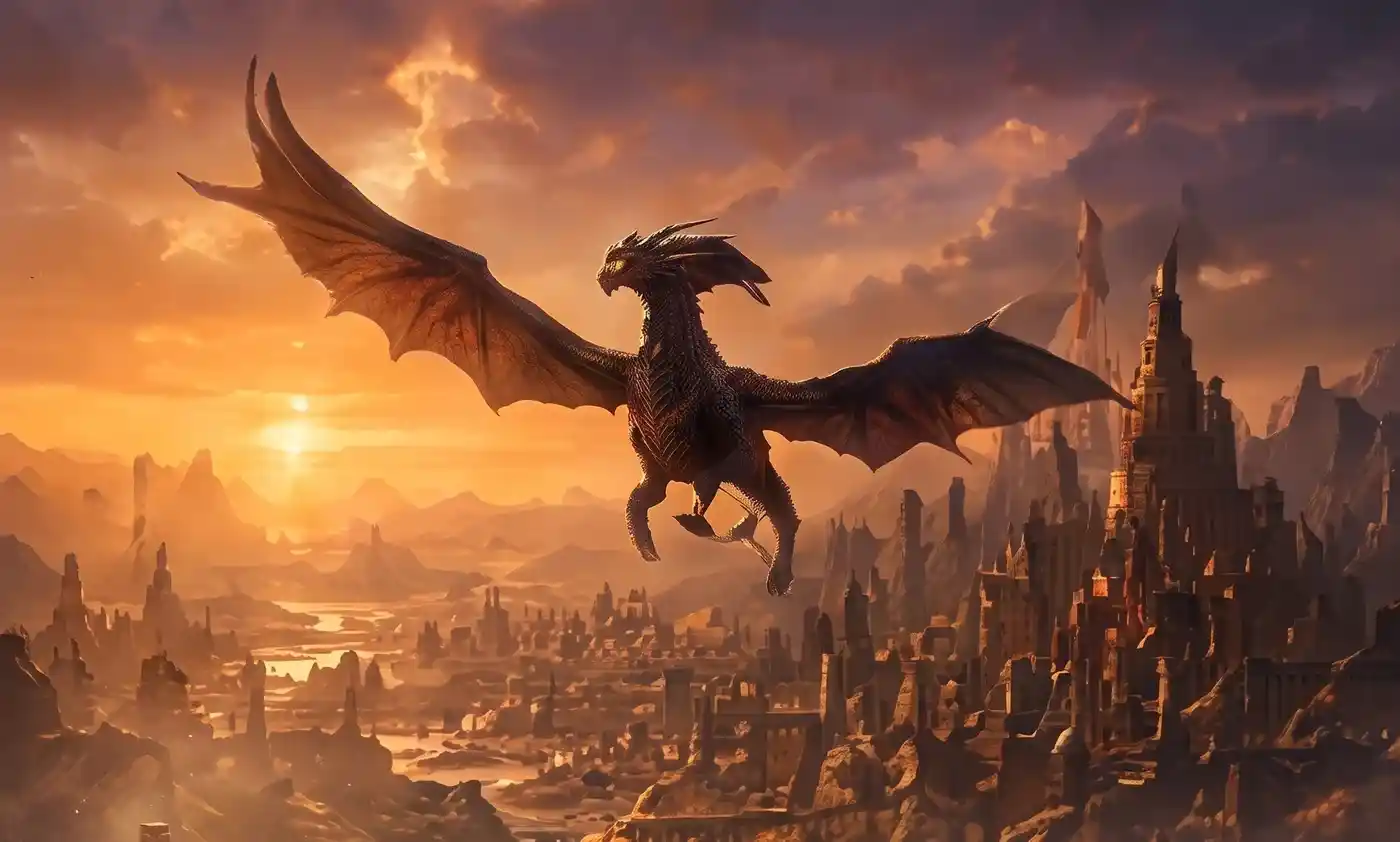
The dragonlords of Old Valyria were the dragon-riding elite of the Valyrian Freehold, the powerful noble families whose dragons, wealth, sorcery, and political influence made them the dominant force in Valyrian society. Valyria had no hereditary king or emperor. Instead, powerful freeholders competed for influence, and the dragonlord families stood at the top of that system.
Understanding the dragonlords helps explain nearly every major part of Valyrian history: the Freehold's expansion across Essos, its wars with Ghis and the Rhoynar, its dependence on slavery, the importance of the Fourteen Flames, House Targaryen's place inside Valyria, and why the Doom destroyed so much power in a single day.
Who Were the Dragonlords of Valyria?
Dragonlords were the most powerful nobles of the Valyrian Freehold. Their defining advantage was access to dragons and the ability to ride and use them in war. In practice, that made them far more dangerous than ordinary aristocratic families. A rival city could build walls and field armies, but those defenses meant far less against dragonfire from the sky.
Valyria's leadership was contested by roughly forty great noble families. The sources describe these houses as exceptionally wealthy, high-born, and strongly associated with sorcery, while the dragon-riding elite became known as dragonlords. The Targaryens were one of these families, but they were not among the most powerful.
For the larger civilization around them, see The Rise and Fall of Valyria.
How Was the Valyrian Freehold Ruled?
The Valyrian Freehold was not technically a kingdom or a conventional empire. It had no single permanent monarch. Freeborn landowners, known as freeholders, had a place in the political system, and the lords freeholder formed the ruling aristocracy.
In theory, freeholders had status within the system. In practice, the wealthiest and most prestigious families had far more influence than ordinary landowners. Archons could be elected from among the freeholders for limited periods, but the deepest power remained with the great houses that controlled wealth, land, magic, and dragons.
This structure helps explain why Valyria was both unified and competitive. The dragonlords could act together against external enemies while still competing fiercely with one another at home. The Freehold was a shared political system, not a single royal dynasty.
Dragons Were the Foundation of Dragonlord Power
Valyrian tradition says the early Valyrians discovered dragons lairing in the Fourteen Flames, the volcanic chain at the heart of the peninsula. Once the Valyrians learned to raise and control dragons, their position changed dramatically.
Dragons became strategic weapons. They could burn armies, destroy fortifications, terrify opponents, and turn wars that would otherwise require enormous ground forces. Valyria used that advantage in conflicts against Old Ghis and later during its expansion across Essos.
The dragonlords therefore were not simply nobles who happened to own unusual animals. Their political status and military power were tied directly to dragonriding. A family with dragons possessed a form of power that ordinary wealth alone could not match.
Did Magic Help the Dragonlords Control Dragons?
Valyrian lore repeatedly connects dragonriding with sorcery, blood magic, and other lost arts, but the surviving material does not provide a complete technical explanation for how dragon control worked. Stories mention magical practices and dragon-binding traditions, while Valyria itself was famous for advanced sorcery.
That uncertainty matters. It is reasonable to say the dragonlords were associated with magic, but it is not safe to claim that every dragon bond depended on one fully documented spell or device. Much of Valyria's knowledge was lost in the Doom, and later generations inherited only fragments of what the dragonlords once understood.
The same pattern appears in Valyrian steel and fused-stone architecture: later people can observe the results, but they do not possess all of the original methods.
Wealth, Mines, and the Dark Side of the Freehold
Dragonlord power was not built on dragons alone. The Freehold controlled enormous resources, trade routes, colonies, roads, mines, and enslaved labor. Beneath the Fourteen Flames, enslaved people were forced into dangerous mines to extract gold, silver, copper, tin, iron, and other valuable materials.
The conditions were brutal. Deep shafts exposed workers to extreme heat, brimstone-filled air, boiling water, molten rock, and stories of firewyrms beneath the mountains. The wealth of Valyria cannot be separated from this system of slavery and exploitation.
Valyria also expanded by conquest. Defeated peoples could be absorbed, displaced, or enslaved, and the Freehold's military dominance made resistance extremely costly. Any account of the dragonlords that focuses only on glamour, dragons, and magical cities misses the violence that supported their power.
The Forty Families and Rivalry Inside Valyria
The great noble houses did not form one peaceful ruling clan. Rivalries among the leading families were part of Valyrian politics. Influence could shift, alliances could change, and the prestige of one house did not mean equal power for every dragonlord family.
This is especially important when discussing House Targaryen. Modern readers often see the Targaryens as the defining Valyrian family because they survived the Doom and later conquered Westeros. In Old Valyria, however, they were only one dragonlord house among many, and the sources explicitly say they were far from the most powerful.
That contrast makes their later history more interesting: the family that became supreme in Westeros had once been a comparatively lesser house inside a much larger dragonlord world.
House Targaryen Before the Doom
House Targaryen belonged to the dragonlord aristocracy and held estates in Valyria. In 114 BC, Daenys Targaryen, later called Daenys the Dreamer, had a prophetic vision of Valyria's destruction. Her father, Aenar Targaryen, believed her warning.
Aenar sold his holdings in Valyria and moved his family, wealth, enslaved people, and dragons to Dragonstone, the westernmost outpost of the Freehold. The family brought five dragons, including Balerion. Rival dragonlords reportedly viewed the move as an act of surrender or cowardice.
Twelve years later, the Doom destroyed Valyria. What had looked like retreat became the decision that allowed the Targaryens to survive. For more on the family's names and later identity, see Targaryen Names and our Valyrian Names guide.
Why Dragonstone Mattered
Dragonstone had already been a Valyrian outpost for generations before the Targaryens relocated there. Its position off the eastern coast of Westeros placed it far enough from the Valyrian peninsula to escape the Doom while still remaining part of the Freehold's western sphere.
After the catastrophe, Dragonstone became the surviving center of Targaryen dragon power. The family remained there for more than a century before Aegon the Conqueror and his sisters Visenya and Rhaenys launched their conquest of Westeros with Balerion, Vhagar, and Meraxes.
That later conquest can make the Targaryens look inevitable in hindsight. They were not. Their dominance depended first on surviving a disaster that destroyed the larger dragonlord civilization around them.
The Doom and the End of the Dragonlord Order
In 102 BC, the Doom of Valyria destroyed the heart of the Freehold. The Fourteen Flames erupted, earthquakes and explosions tore through the peninsula, cities and settlements were destroyed, and most of Valyria's dragonlords and dragons died in the catastrophe.
The destruction was political as well as physical. The Freehold lost its ruling families, institutions, military structure, records, magical knowledge, and economic center. Colonies and successor states were suddenly left without the authority that had dominated them for generations.
One surviving dragonlord, Aurion, tried to return to Valyria with a large host and his dragon after the Doom. He disappeared, reinforcing the terrifying reputation of the ruined peninsula. House Targaryen, already established on Dragonstone, became the last surviving dragonlord house.
Were the Targaryens the Last Dragonlords?
Some dragonlords who were outside Valyria survived the initial Doom, but they did not long outlive the collapse of the Freehold. House Targaryen was the dragonlord family that survived as a continuing dragon-riding dynasty because it had already relocated to Dragonstone twelve years earlier.
Over time, Targaryen dragonriding became the surviving image of what a dragonlord looked like. That can obscure the older truth: before the Doom, the Targaryens belonged to a much larger elite of rival families whose names, fortunes, and dragons were mostly lost.
Why the Dragonlords Still Matter to Valyrian Lore
The dragonlords explain how Valyria became powerful, but they also reveal why the civilization was so unequal. Their world combined extraordinary technology, sorcery, architecture, metallurgy, and dragonriding with slavery, conquest, dangerous mining, and aristocratic competition.
They also provide the missing context for House Targaryen. The Targaryens did not create dragonlord culture; they inherited one surviving branch of it. Their later kings, queens, dragonriders, and family traditions make more sense when viewed as remnants of a much larger Valyrian system.
To continue the topic, explore Myths and Legends of Valyria or the full Valyria & High Valyrian hub.
Sources and Further Reading
For source-based reference, see the entries on the dragonlords, the Valyrian Freehold, and Aenar Targaryen at A Wiki of Ice and Fire. These pages summarize material from The World of Ice & Fire, Fire & Blood, and the main novels while distinguishing established lore from later or semi-canon details.
Frequently Asked Questions
Who were the dragonlords of Old Valyria?
The dragonlords were the most powerful nobles of the Valyrian Freehold, families whose ability to possess and ride dragons gave them exceptional military and political influence. They stood above ordinary freeholders in practical power and dominated the Freehold's ruling elite before the Doom of Valyria.
How many dragonlord families were there in Valyria?
Valyrian leadership was contested by roughly forty great noble families. The sources describe the ruling elite as wealthy, high-born, and associated with sorcery, while dragon-riding families formed the dragonlord class. Some later material describes forty dragon-riding families, so exact wording should be handled with care.
Were the Targaryens the most powerful dragonlords?
No. House Targaryen was one of Valyria's dragonlord families, but the sources explicitly state that it was far from the most powerful. The family's later importance came from surviving the Doom after Aenar Targaryen moved to Dragonstone following Daenys the Dreamer's warning.
How did the dragonlords control dragons?
The lore associates Valyrian dragonriding with inherited traditions, training, sorcery, and dragon-binding practices, but it does not preserve one complete technical explanation. Much of the Freehold's knowledge was destroyed in the Doom, so later characters understand only parts of the older dragonlord system.
Why did House Targaryen survive the Doom?
Daenys Targaryen foresaw Valyria's destruction twelve years before the Doom. Her father, Aenar, sold the family's holdings in Valyria and moved the household, wealth, and dragons to Dragonstone in 114 BC. Because they were already away from the peninsula, the Targaryens survived the catastrophe of 102 BC.