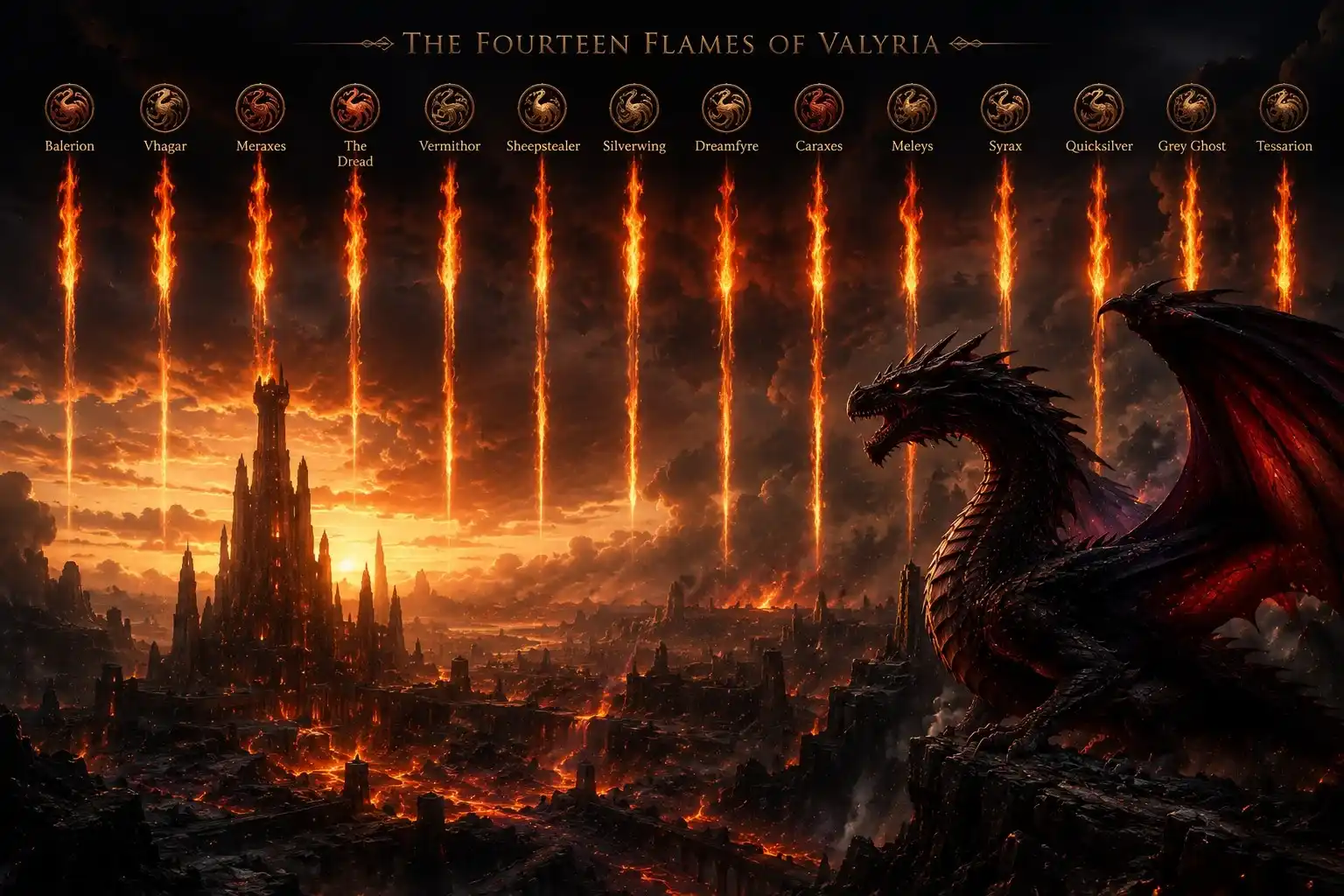
The Fourteen Flames of Valyria were an immense chain of volcanoes stretching across the Valyrian peninsula. They were central to the rise of the Valyrian Freehold: dragons laired among the volcanic peaks, deep mines supplied valuable metals, and enslaved workers were forced into deadly shafts beneath the mountains. In 102 BC, the Doom of Valyria erupted from the same volcanic region and destroyed the heart of the Freehold.
The Fourteen Flames therefore sit at the center of Valyrian history in two different ways. They helped make Valyria powerful, and they were also part of the catastrophe that ended it. The details below separate established lore from in-world beliefs and theories.
What Were the Fourteen Flames?
The Fourteen Flames were a vast volcanic chain on the Valyrian peninsula in Essos. They were not a single mountain or one isolated volcano. Reference material describes them as an immense range of living volcanic mountains, with molten rock and extreme heat beneath the surface. Their fires were visible in the old Freehold and became one of the defining features of Valyria's landscape.
Before Valyria became an empire, the people of the peninsula were described as humble shepherds. Their history changed when they discovered dragons lairing in the Fourteen Flames. From that point, the Valyrians learned to raise and control dragons and gradually built the most powerful civilization in Essos.
For a broader account of that rise, see The Rise and Fall of Valyria.
Where Were the Fourteen Flames Located?
The Fourteen Flames extended across the neck of the Valyrian peninsula. The peninsula projected south from Essos into the Summer Sea and formed the heartland of the Valyrian Freehold. After the Doom, much of this geography was shattered. Low-lying land collapsed or flooded, islands formed, and the Smoking Sea separated parts of the ruined peninsula from the Lands of the Long Summer.
Some of the original volcanic peaks may now lie beneath the Smoking Sea. Other fires or volcanic activity appear to have survived. Centuries after the Doom, travelers passing near Valyria still report ominous red light and smoke in the region.
Dragons and the Fourteen Flames
The Valyrians discovered wild dragons lairing in the Fourteen Flames, and their mastery of those creatures transformed their future. Dragons gave the Freehold a military advantage that ordinary armies could not easily match. Valyria used dragonpower in wars against Old Ghis and later against other rivals across Essos.
Valyrian tradition also gave the relationship a mythic meaning. The Valyrians believed dragons were the children of the volcanoes, and some tales claimed that Valyrians themselves were kin to dragons. Those beliefs are important to Valyrian identity, but they should be treated as cultural tradition rather than a scientifically proven origin story.
Other traditions give different explanations for where dragons came from. Asshai'i tales place ancient dragons farther east, while Qartheen stories describe a second moon cracking open. For those competing legends, see Myths and Legends of Valyria.
The Mines Beneath the Fourteen Flames
Deep mines ran beneath the volcanoes. Valyria sent enslaved people from many conquered nations into those shafts to search for gold, silver, copper, tin, iron, and other ores. The wealth taken from the mines supported the Freehold, but the human cost was enormous.
The deeper the shafts went, the more dangerous the conditions became. The rock could be too hot to touch. Air filled with brimstone burned the lungs. Miners could break through into steam, boiling water, or molten rock. Some passages were so low that workers had to crawl or bend while moving through them.
The worst enslaved workers were sent into the deepest, most dangerous parts of the mines. Deaths were routine, and the Freehold continued digging despite the loss of life. This makes the Fourteen Flames not only a symbol of Valyrian wealth, but also a reminder that much of that wealth depended on slavery and extreme exploitation.
Firewyrms in the Valyrian Mines
Old accounts say that firewyrms lived beneath the Fourteen Flames. Firewyrms are wingless, fire-breathing creatures that can bore through rock, soil, and stone. They are possibly related to dragons, although the exact relationship is not fully explained.
Enslaved miners reportedly encountered them in the deep shafts. Burned and blackened corpses were sometimes found in places where the surrounding rock had been cracked or riddled with holes. The stories say the mines kept expanding even after such discoveries.
These accounts are one reason the underground world of Valyria feels as dangerous as the dragons above it. Fire, molten rock, poisonous air, forced labor, and firewyrms all appear in descriptions of the mines beneath the volcanoes.
How the Fourteen Flames Helped Build Valyrian Power
The Fourteen Flames contributed to Valyria's rise in at least two major ways. First, they were the place where the early Valyrians discovered dragons. Second, the mines beneath them produced valuable metals and resources. Dragons supplied unmatched military power, while mineral wealth supported expansion and industry.
Over time, the Valyrian Freehold grew into a vast civilization ruled by competing dragonlord families. Valyria defeated the Old Empire of Ghis, fought the Rhoynar, founded colonies and roads, and spread its language and culture across much of western Essos.
The volcanoes therefore were not a background detail. They were tied to the Freehold's military power, economy, mythology, and identity. The same landscape that enriched Valyria eventually became the center of its destruction.
The Doom of Valyria
In 102 BC, the Doom of Valyria destroyed the Freehold. The catastrophe involved the eruption of all of the Fourteen Flames, not thirteen of them. Great earthquakes destroyed settlements, mountains exploded, and fire and molten rock overwhelmed the region. The heat was so intense that even dragons were killed.
The Valyrian peninsula was broken apart. The ground collapsed and the surrounding sea flooded into the shattered landscape, helping create the Smoking Sea between the new islands and ruins. The political center of the Freehold disappeared almost at once, along with most of its dragonlords, dragons, records, and magical knowledge.
House Targaryen survived because Aenar Targaryen had moved his family and dragons to Dragonstone twelve years earlier after the prophetic warning of his daughter Daenys. For the full catastrophe and its aftermath, read The Doom of Valyria.
What Caused the Doom?
The exact cause is deliberately unresolved. The most common explanation inside the lore is a natural volcanic catastrophe: the Fourteen Flames erupted on an extraordinary scale and triggered earthquakes, explosions, flooding, and widespread destruction.
There is also a magical theory associated with Septon Barth. According to this idea, Valyrian sorcerers may have used magic to restrain or control the volcanoes. Political conflict among the dragonlords allegedly led to the deaths of too many of those mages, allowing the volcanic forces to escape control.
That explanation remains a theory, not a confirmed answer. Other in-world beliefs treat the Doom as divine punishment for Valyria's slavery, conquest, blood magic, and other crimes. The strongest factual statement is simply that the Fourteen Flames erupted and the Freehold was destroyed; the ultimate reason remains unknown.
What Remained After the Doom?
The Fourteen Flames did not vanish from the lore after the catastrophe. Some peaks may have been submerged beneath the Smoking Sea, while later travelers still associated the ruined region with fire, smoke, and volcanic activity.
In A Dance with Dragons, Tyrion Lannister sees a dull red glow while sailing near the Valyrian peninsula. Moqorro treats the fires with religious awe and warns against looking too deeply into them. Elsewhere, sailors repeat the superstition that anyone who sees the fiery mountains of Valyria rising above the waves will die a terrible death.
Those later reports do not tell us exactly how many volcanoes remain active or visible. They do show that the fires of Valyria continued to shape the fear and mythology surrounding the ruins centuries after the Doom.
Why the Fourteen Flames Matter to Valyrian Lore
The Fourteen Flames summarize the central contradiction of Valyria. The volcanoes were connected to dragons, mineral wealth, expansion, and imperial power, yet the same volcanic landscape became the center of the Doom. Valyria's greatest advantages and its destruction are therefore linked to the same place.
They also connect several major themes of Valyrian history: dragonriding, slavery, firewyrms, mining, magic, environmental danger, and lost knowledge. Understanding the Fourteen Flames makes the wider story of the Freehold easier to understand, from its first dragonlords to its final day.
For more on the people who ruled that civilization, read The Dragon Lords of Old Valyria. You can also explore the full topic cluster at Valyria & High Valyrian.
Sources and Further Reading
For source-based lore, compare the documented material on the Fourteen Flames, firewyrms, and the Doom of Valyria at A Wiki of Ice and Fire. These pages cite the relevant chapters from A Feast for Crows, A Dance with Dragons, and The World of Ice & Fire.
Frequently Asked Questions
What were the Fourteen Flames of Valyria?
The Fourteen Flames were an immense chain of volcanoes on the Valyrian peninsula. Dragons laired among them, valuable mines ran beneath them, and the volcanoes were central to the rise of the Valyrian Freehold. In 102 BC, the eruption of the Fourteen Flames formed part of the catastrophe known as the Doom of Valyria.
Did the Valyrians find dragons in the Fourteen Flames?
Yes. Valyrian history says the early Valyrians discovered dragons lairing in the Fourteen Flames and eventually learned to raise and control them. Valyrian tradition also claimed that dragons were children of the volcanoes, although other cultures preserved different stories about the original birthplace of dragons.
Were there mines beneath the Fourteen Flames?
Yes. Deep mines beneath the volcanoes produced gold, silver, copper, tin, iron, and other ores. Enslaved people from conquered nations were forced to work in extreme heat, brimstone-filled air, and dangerous shafts where steam, boiling water, molten rock, and firewyrms could be encountered.
Did all Fourteen Flames erupt during the Doom?
Yes. The lore describes the Doom as an eruption of all of the Fourteen Flames. Earthquakes destroyed settlements, mountains exploded, molten rock filled the air, and the peninsula was fragmented as the Smoking Sea formed around the ruins. The disaster destroyed the heart of the Valyrian Freehold.
Was the Doom of Valyria caused by magic?
The exact cause is unknown. Most accounts treat the Doom as a natural volcanic catastrophe, while a theory associated with Septon Barth suggests Valyrian magic may once have restrained the volcanoes and later failed. That magical explanation is an in-world theory, not a confirmed fact.