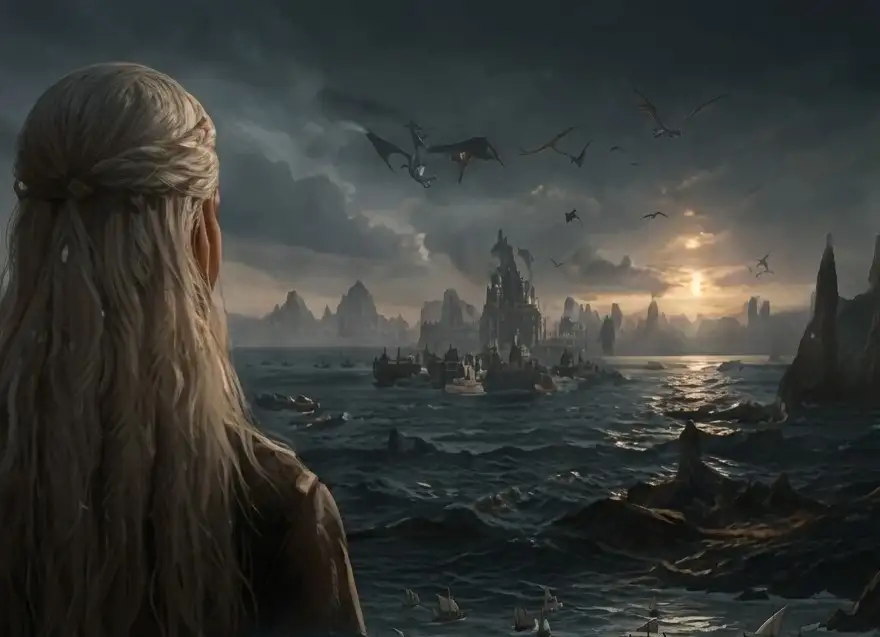
Valyrian culture and traditions were shaped by dragonriding, aristocratic family power, High Valyrian language, slavery, sorcery, mining, religious diversity, and the political structure of the Valyrian Freehold. The civilization is often remembered through dragons and Valyrian steel, but its culture was much broader—and much darker—than those famous symbols suggest.
This guide separates documented customs from later assumptions. Not every Valyrian was a dragonlord, not every family followed the same marriage practices, and many details of Valyria's magic disappeared in the Doom. The strongest picture comes from looking at politics, family life, language, religion, labor, and legacy together.
What Was Valyrian Culture Like?
Valyria was a highly stratified civilization dominated by wealthy noble families, especially those with dragons. The Freehold expanded through conquest, trade, roads, colonies, mines, and military force. It also depended heavily on enslaved labor. Dragons gave Valyria unmatched battlefield power, while mining and metallurgy helped support its wealth.
At the same time, Valyria produced a prestige language, distinctive architecture, advanced metalworking, and magical traditions that later generations could not fully reproduce. This combination of cultural achievement and brutal exploitation is essential to understanding the Freehold accurately.
For the larger historical arc, see The Rise and Fall of Valyria.
Social Order and the Valyrian Freehold
Valyria was not ruled by a permanent king or emperor. Freeborn landowners known as freeholders formed part of the political system, while powerful noble houses competed for influence. At times, archons were elected for temporary leadership, but the greatest practical power rested with the richest and most prestigious families.
Dragonlords stood at the top of that elite. Their dragons gave them military strength that ordinary nobles could not match. Roughly forty great houses contested power within the Freehold, and House Targaryen was one of them—though the Targaryens were not considered among Valyria's strongest families.
That distinction matters because modern readers often see Valyria through the later Targaryen dynasty. In Old Valyria, the Targaryens were only one branch of a much larger aristocratic world. Read more in The Dragonlords of Old Valyria.
Dragonlord Identity and Bloodlines
Among dragonlord families, lineage carried enormous importance. Close-kin marriage was a documented custom among the dragonriding aristocracy. Brothers could marry sisters; when that was not possible, uncles and nieces, aunts and nephews, or close cousins might be paired. The stated purpose was to keep the bloodline pure.
Polygamous marriages were also accepted among Valyrians, though they were less common. House Targaryen continued some of these customs after leaving Valyria, which later caused conflict with the Faith of the Seven in Westeros.
It is important not to turn a dragonlord custom into a rule for every Valyrian person. Sources specifically note that incestuous marriage was not commonly practiced by people outside dragonrider families. Valyrian culture included nobles, freeholders, artisans, soldiers, merchants, enslaved people, and many communities beyond the dragonlord elite.
High Valyrian Language and Writing
High Valyrian was the prestige language of the Valyrian Freehold. It was spoken by the nobility and became culturally influential across conquered territories. Valyrian languages were written with a glyphic script, and the language remained prestigious even after the Doom.
Over centuries, everyday speech in former Valyrian territories changed. The Free Cities developed their own Valyrian varieties, while the dialects of Slaver's Bay were strongly influenced by Old Ghiscari. These descendant forms are often called bastard or Low Valyrian.
High Valyrian survived as a learned or elite language in some places, including among members of House Targaryen. If you want to study the language rather than only its history, see How to Learn High Valyrian and our Essential High Valyrian Words guide.
Religion and the Old Gods of Valyria
Valyria had a pantheon of gods rather than a single official deity. Names recorded for old Valyrian gods include Balerion, Meraxes, Vhagar, and Syrax. House Targaryen later gave those names to dragons, preserving part of that older religious tradition.
The Freehold was also known for religious tolerance. Different faiths could exist within its territories, and some groups that rejected that tolerance left Valyria and founded communities elsewhere. The cities of Qohor and Norvos, for example, were associated with religious groups that had departed Valyria.
One scholarly interpretation goes further and claims some dragonlords viewed all religions cynically, tolerating multiple faiths because divided beliefs made subjects easier to rule. That is an attributed interpretation, not a universal statement about every Valyrian's personal faith. Other evidence shows the old gods themselves continued to be worshiped, including among parts of the Old Blood of Volantis after the Doom.
Dragons, Magic, and Lost Knowledge
Dragons were central to elite Valyrian identity, warfare, and politics. The early Valyrians discovered dragons around the Fourteen Flames and eventually learned to use them in war. Valyrian accounts also connect dragon control with whips, magic horns, and sorcery.
Valyria was famous for powerful magic, but much of the technical knowledge behind it was lost. Later generations associated the Freehold with blood magic, fused stone, dragon-binding, glass candles, and other supernatural practices. Some claims are well established within the setting; others are fragmentary or filtered through rumor.
The same caution applies to Valyrian steel. The material clearly exists and surviving blades can be reforged, but the original process for creating new Valyrian steel was lost after the Doom. A culture article should therefore distinguish surviving artifacts from techniques that no longer have a complete explanation.
Valyrian Steel and Craftsmanship
Valyrian steel became one of the most famous surviving products of the Freehold. The blades are lighter, stronger, harder, and sharper than ordinary castle-forged steel, with distinctive rippled patterns created during forging. Noble houses in Westeros treated such weapons as priceless heirlooms.
Valyria also left roads, towers, fortifications, and fused-stone structures that later peoples struggled to imitate. The Freehold's reputation for advanced craftsmanship is therefore not based on one artifact alone. Its surviving works suggest a society in which metallurgy, engineering, and magic sometimes overlapped.
If your interest is fantasy weapon naming rather than historical lore, the Sword Name Generator is a separate creative tool; it should not be treated as a source for canon Valyrian steel history.
Slavery and the Cost of Valyrian Power
Valyrian culture cannot be described responsibly without slavery. The Freehold conquered peoples across Essos and forced many captives into labor. Enslaved workers were sent into the mines beneath the Fourteen Flames, where they extracted gold, silver, copper, tin, iron, and other resources in deadly conditions.
The Ghiscari wars show how conquest and enslavement worked together. After the final defeat of Old Ghis, many Ghiscari were killed and others were enslaved. Their territories were absorbed into the Freehold, and the older Ghiscari culture was heavily disrupted.
This matters because Valyria is often romanticized through dragons, silver hair, magic, and beautiful architecture. Those elements existed alongside exploitation on a massive scale. The wealth and power of the Freehold were supported by systems that caused enormous suffering.
Marriage, Family, and Inheritance
Family strategy was especially important among dragonlords because dragons, property, prestige, and bloodline were tied together. Close-kin marriages helped keep assets and dragonriding identity concentrated within a house. This custom later became one of the most recognizable Targaryen traditions.
However, the surviving evidence does not give us a complete universal inheritance code for ancient Valyria. It is unclear whether the Freehold consistently followed male-preference primogeniture, equal inheritance, or another formal rule across all great houses. Some sources suggest marriage between an elder daughter and a younger brother could reduce succession conflict, but the evidence is not strong enough to present one simple system as settled fact.
That uncertainty is a useful reminder: Valyrian family culture is documented in pieces, not as a complete surviving legal handbook.
Appearance and Valyrian Identity
Valyrian noble families are famously associated with pale silver-gold or platinum hair and eyes described in shades such as purple, lilac, or violet. These features are strongly associated with Targaryens and can appear among other families of Valyrian descent.
Appearance was culturally important because it could signal ancestry, but it was not proof that every Valyrian belonged to a dragonlord family. The Freehold contained a much larger population than its aristocratic elite, and Valyrian identity included language, law, status, origin, and political belonging as well as appearance.
For names tied to that heritage, see Valyrian Names: Canon Examples & Naming Guide.
What Survived After the Doom?
The Doom of Valyria destroyed the political and geographic center of the Freehold in 102 BC. Most dragonlords, dragons, records, and institutions vanished. House Targaryen survived because Aenar Targaryen had already moved his family and dragons to Dragonstone twelve years earlier after Daenys the Dreamer's warning.
Valyrian culture did not disappear completely. The Free Cities preserved different pieces of the old language and heritage. Volantis retained a powerful Old Blood aristocracy, some communities continued worshiping Valyrian gods, and Valyrian-descended families survived beyond the ruined peninsula.
High Valyrian remained prestigious, while descendant dialects developed across Essos. Targaryen dragonriding, naming traditions, marriage customs, and Valyrian steel preserved other fragments. For the catastrophe itself, read The Doom of Valyria.
Common Myths About Valyrian Culture
Myth: Every Valyrian was a dragonlord
Reality: Dragonlords were an elite minority. Valyrian society also included freeholders, other nobles, workers, soldiers, artisans, traders, subject peoples, and enslaved populations.
Myth: Every Valyrian family practiced incest
Reality: Close-kin marriage is specifically documented as a dragonlord custom and was not commonly practiced by people outside dragonrider families.
Myth: Valyria had one official religion
Reality: Valyria had multiple gods and was known for broad religious tolerance. Different faiths existed inside the Freehold, and some religious communities left because they rejected that tolerance.
Myth: Everything about Valyrian magic is known
Reality: Many Valyrian magical practices are only partially documented, and much knowledge was lost in the Doom. Later characters understand the results better than the original methods.
Why Valyrian Culture Still Matters
Valyrian culture matters because its legacy shapes much of the later world. Targaryen politics, dragonriding, family customs, High Valyrian, the Free Cities, Valyrian steel, old roads, religious traditions, and memories of empire all trace back to the Freehold.
It also works as a caution against reducing a civilization to its glamorous symbols. Valyria produced remarkable language, engineering, magic, and craftsmanship, but it also depended on conquest and slavery. Both sides belong in an accurate account of its culture.
To continue exploring the topic, visit the Valyria & High Valyrian hub.
Sources and Further Reading
For source-based lore, see the entries on the Valyrian Freehold, Valyrian languages, and old gods of Valyria at A Wiki of Ice and Fire.
Frequently Asked Questions
What were the main traditions of Valyrian culture?
Documented Valyrian traditions included dragonlord family customs, close-kin marriage among dragonriders, High Valyrian language, worship of multiple gods, religious tolerance, dragonriding, sorcery, and elite competition within the Freehold. Valyrian society also depended heavily on slavery, conquest, mining, and the labor of subject peoples.
Did all Valyrians marry their relatives?
No. Close-kin marriage was a custom among dragonlord families, who used it to preserve their bloodlines. Sources specifically note that this was not commonly practiced by people outside dragonrider families. It is therefore inaccurate to describe incest as a universal custom of every person in Valyrian society.
What religion did ancient Valyria follow?
Valyria had a pantheon of gods, including Balerion, Meraxes, Vhagar, and Syrax, but the Freehold was also known for religious tolerance. Multiple faiths existed within its territories. Some scholars even argued that dragonlords promoted tolerance for political reasons, although that is an interpretation rather than a universal statement about private belief.
What language did the Valyrians speak?
The nobility of the Valyrian Freehold spoke High Valyrian. After the Doom, regional forms evolved in the Free Cities and Slaver's Bay, creating descendant varieties often called bastard or Low Valyrian. High Valyrian survived as a prestigious learned language among some elites and Valyrian-descended families.
What parts of Valyrian culture survived the Doom?
House Targaryen preserved dragonriding traditions, names, and some marriage customs on Dragonstone. High Valyrian survived as a prestige language, while descendant dialects spread across Essos. Valyrian gods continued to be worshiped in some communities, and artifacts such as Valyrian steel and fused-stone structures survived even when their original methods were lost.